How to Run a Profitable Mini Session Day (a Photographer's Playbook)
Trevor O'Hare ·
Mini session days are some of the most profitable time a photographer can put on the calendar. You light and style one setup, then run a line of short sessions through it, and a single booked day can carry a whole month of income. If you have been trying to work out how to run mini sessions that actually turn a profit, here is the full playbook: the room math, how many slots fit in a day, how to keep clients moving, and how to price your slots so the studio pays for itself early.
Start with the room math
The only fixed cost of a mini day is the room, so start there. The longer you book, the less each hour costs. A half day is four hours at 20% off the hourly rate, and a full day is eight hours at 40% off. That block discount is what makes a mini day work: you buy the time in bulk, then resell it in slices.
Here is a real weekday example. A half day in Studio A runs $240, which works out to $60 an hour. That number is your entire cost of goods for the day. Everything you sell on top of it is margin. Weekday rates are lower than weekends, so if your minis do not have to land on a Saturday, a weekday keeps that base cost down and the calendar more open.
Figure out how many sessions fit in a day
Once you know the block, the next question is how many clients you can run through it. That comes down to two things: how long you actually shoot each client, and how much turnaround you leave between them for a quick reset and a wardrobe change.
Here is roughly what fits, depending on how you pace it:
| Shoot time per client | Turnaround | Slot spacing | Half day (4 hrs) | Full day (8 hrs) |
|---|---|---|---|---|
| 15 min | 10 min | 25 min | 9 clients | 18 clients |
| 20 min | 10 min | 30 min | 8 clients | 16 clients |
| 30 min | 15 min | 45 min | 5 clients | 10 clients |
Two honest notes. Leave the turnaround real, because the client who runs long is the one who throws off everyone behind them. And on a full day, trim a slot or two for a lunch and a mid-day reset. A day you can actually sustain beats a spreadsheet you can't.
Keep the setup the same for everyone
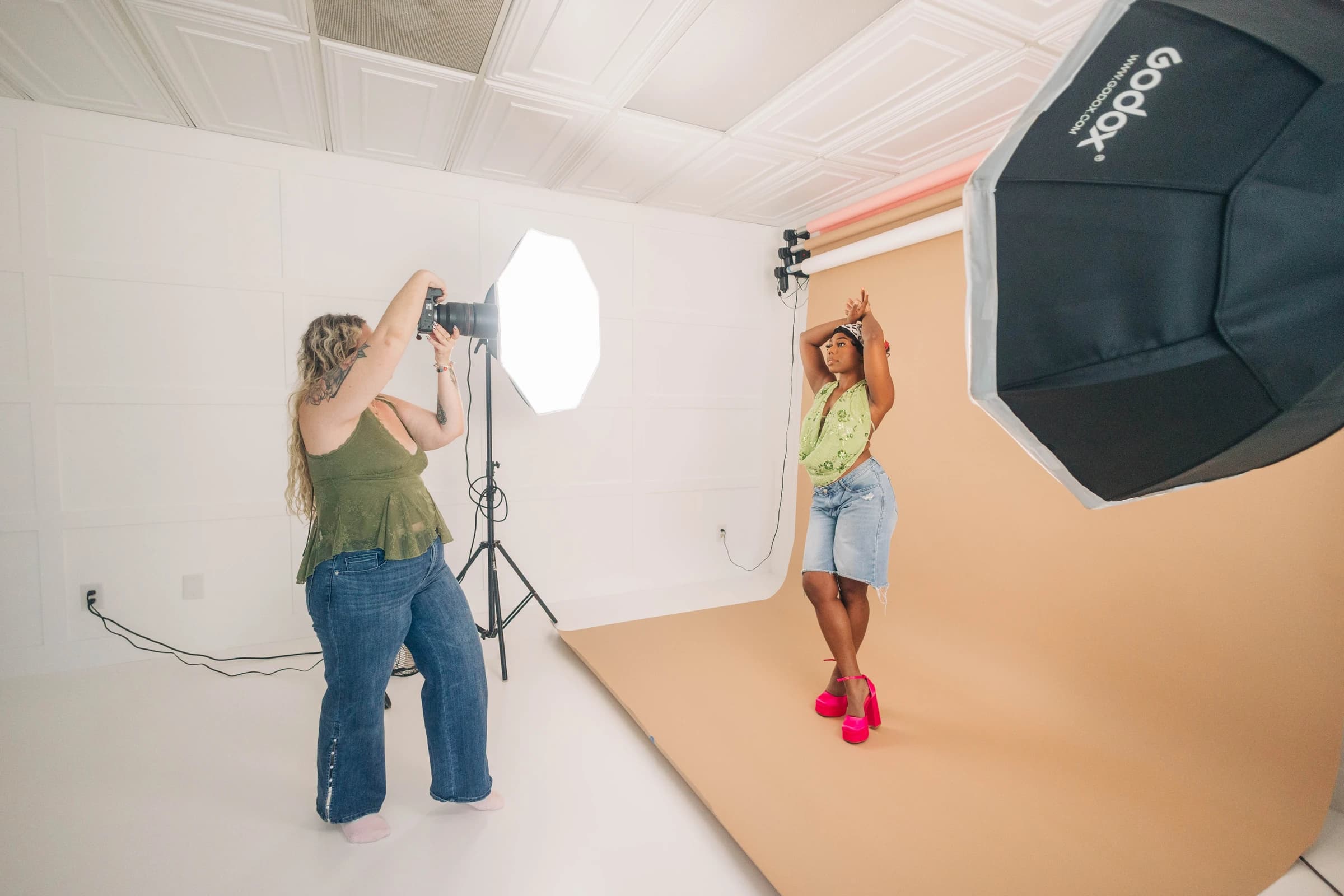
This is the whole point of minis, and it is the part new photographers skip. You are not styling a session, you are styling a station. Light it once, dial in your look once, and then every client steps into the same frame. The moment you start rearranging furniture between families, the profit leaks out through your turnaround.
That is why a furnished, neutral room does the heavy lifting here. Studio A stays styled year-round with a full-size bed, a rattan daybed, a prop shelf, and seamless paper backdrops, so your set does not change between clients unless you want it to. Pick one backdrop or one corner, commit to it for the day, and let the consistency do the work. If you want a seasonal hook, the styled Christmas Sets go up October 9 through December 13 and book by the hour like any rental, which makes them a natural anchor for holiday minis.
Run the day so clients flow
A mini day lives or dies on client flow. A few things keep it calm:
- Stagger arrivals to your cadence. Give each family its own start time that matches your slot spacing, not one blanket call time. Free parking right out front means nobody circles the block, so arrivals stay on schedule.
- Give people a place to land. Have a spot for the next client to wait and change so they are ready the second you call them. If you want a dedicated green room, you can book both studios and use the second room purely as a waiting and wardrobe space.
- Build in outfit-change time. If your minis include a look change, that lives inside your turnaround, not your shoot time. Price and pace for it up front.
- Offer camera-ready clients. An independent hair stylist works on site, so families can book styling and show up shoot-ready without you touching a comb.
Every confirmed booking gets its own door code, live ten minutes before your start, so there are no keys to juggle and you control when clients come in. Plan your setup as the first slot of the block rather than counting on early access; the ten-minute window is a head start, not a setup hour.
Price your slots so the room pays for itself
Here is the simplest way to price a mini day. Take your room cost, that half day in Studio A at $240, and set your per-client mini price so that just two booked clients cover the entire room. Sell eight slots, and the first two pay the rent while the other six are yours (minus your time and editing).
Frame it that way and the pressure comes off. You are not trying to fill every slot to break even. You break even by lunch, and the back half of the day is profit. When you do sell out, a room that cost $60 an hour turns into the most efficient day on your calendar.
If you run minis monthly, membership changes the math
If mini days are a regular part of your business, look at membership before you book the next one. It is $19 a month and takes 20% off everything, stacked on top of the half and full day discounts. Membership pays for itself once your rental spend passes $95 in a month, and a single mini day usually clears that on its own. There is an annual option too, with two months free.
For most photographers running minis monthly, that 20% comes straight off the one fixed cost of the day, which means it lands straight in the margin. We laid out the full rate card and every discount in what it costs to rent a studio in Orlando, if you want to run your own math.
Book your mini session day
Mini days reward the photographers who plan them like a small production: one setup, a real schedule, and a price that covers the room early. The space is built to make that easy. Rates can shift as we settle into our new home in Altamonte Springs, so the pricing page always shows the current numbers and open dates. Pick your day, block the time, and go fill it. We will have the room ready.